03
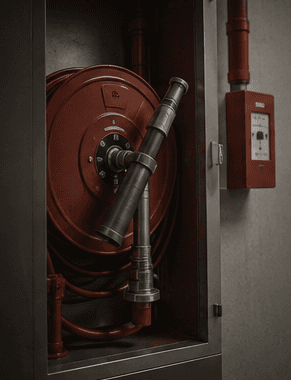
Fire fighting & fire alarm
Detection, suppression and alarm integrated into the wider system so a fire event drives the whole project's response.
Detection & alarm · Suppression · Project-wide response

Public address and background audio zoned to the project — and ready to carry an evacuation message the moment the fire panel asks for it.
Design · Supply · Install · Integrate · Maintain
Most people experience a sound system as background music in a lobby or a page for a colleague. The same loudspeakers, amplifiers and zoning have a second job: when a fire panel goes into alarm, they must stop the music and deliver a clear, intelligible message to the people who need to move.
That dual role shapes the design. Zones follow the building's evacuation plan. Loudspeakers are placed for intelligibility, not just coverage. Amplifiers and lines are monitored, so a fault is known before it is needed.
We design sound systems as part of the wider security and life-safety picture: tied to the fire alarm, controllable from the command room and, where the project wants it, carrying the hotel's playlist as well as its safety.
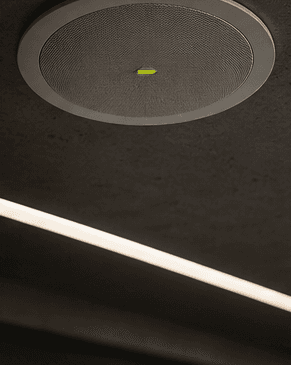
At a glance
Announcements to the zones that need them, and only those.
Phased, pre-recorded and live messages on the fire panel's command.
Music sources routed to lobbies, restaurants and pools.
Microphone stations for reception, security and management.
Prayer times, opening hours and safety notices.
Faults reported to the panel and the command room.
IP-based distribution across large sites and multiple buildings.
The alarm always wins over music and pages.
Volume follows the noise in the room.
Fire alarm, command room, BMS and the hotel's systems.
Every project is composed from a small number of well-understood parts. These are the ones that matter for this discipline.
Ceiling loudspeakers
The standard for corridors, offices and lobbies.
Wall & cabinet loudspeakers
Rooms with no ceiling access or higher output needs.
Horn loudspeakers
Car parks, plant rooms and outdoors.
Column & line-array loudspeakers
Long rooms, atria and prayer halls.
Sound projectors
Directional coverage for corridors and outdoors.
Fire-rated loudspeakers
For voice evacuation applications.
PA & voice alarm controllers
The routing brain, with priority and supervision.
Amplifiers
100 V line amplifiers sized to each zone.
Call stations
Paging microphones with zone selection.
Message players
Pre-recorded evacuation and information messages.
Network audio interfaces
Audio over IP between buildings.
Audio sources
Music, radio and streaming inputs.
Fire-rated cabling
Keeps voice alarm working during an event.
Battery back-up
The system stays on when power does not.
Racks & monitoring
Equipment rooms with supervision.
Priority is engineered, not hoped for: an alarm message from the fire panel overrides every other source, in every zone it addresses.
Source
Microphone, message player or music
Controller
Routes by priority: alarm, page, music
Amplifier
Powers each zone's line
Loudspeaker zones
Areas that follow the evacuation plan
Supervision
Line and amplifier faults reported
Fire panel & command room
Alarm command in; status out
Safe & Sound carries every discipline, so this system is designed from day one to talk to the others on the project.
Fire alarm
The panel triggers phased evacuation messages zone by zone, and receives the PA's fault states.
Command rooms
Live announcements and message triggering from the desk; system status on the platform.
Intercom
Emergency help points and paging on the same audio network where appropriate.
CCTV
Announcements can be triggered from video events — a warning to a person in a restricted area.
Smart home & BMS
Music scenes and schedules follow the building's mode.
A typical sequence
The fire panel confirms an alarm on floor four.
The PA stops the music on that floor and plays the alert message; adjacent floors receive the standby message.
Reception uses the call station to give live instructions to the lobby.
The command room sees message status and any loudspeaker line fault in real time.
Sound systems matter most in buildings full of people who do not know the layout: hotels and resorts, malls and retail, universities, hospitals, factories with noisy floors, Nile cruise vessels and transport infrastructure.
A deliberately narrow stack, supplied through authorised channels only. The final selection is made per project, against the specification and the budget.




For public address and voice alarm we work with Bosch and Honeywell systems, and with Axis and Hikvision network audio where an IP loudspeaker approach suits the site.
Zone plan aligned with the evacuation strategy, loudspeaker layout and tapping for intelligibility, amplifier and controller sizing, message scripts, fire-alarm interface design and cabling specification.
Loudspeakers, amplifiers, controllers and call stations from authorised channels, with messages recorded and approved before commissioning.
Loudspeakers and cabling installed with the ceiling and electrical contractors, zones balanced and intelligibility checked, the fire interface proven, and operators trained on paging and messages.
Zone schedule, as-built drawings, message library, interface matrix with the fire panel, and a lifecycle plan for amplifiers and batteries.
Scheduled listening tests in every zone, supervision and battery checks, message and schedule updates, and a report to the client.
We stay involved after handover. Every system leaves us with a maintenance path, a named point of contact and a report you can read.
A loudspeaker that has failed makes no noise about it. Supervision reports the line, but only a person can confirm the words are clear in the room.
See the three maintenance tiersSystems that are designed alongside this one on most projects.
Tell us about the project. We’ll shape the solution around it — the design, the bill of quantities, the named team and three maintenance options.